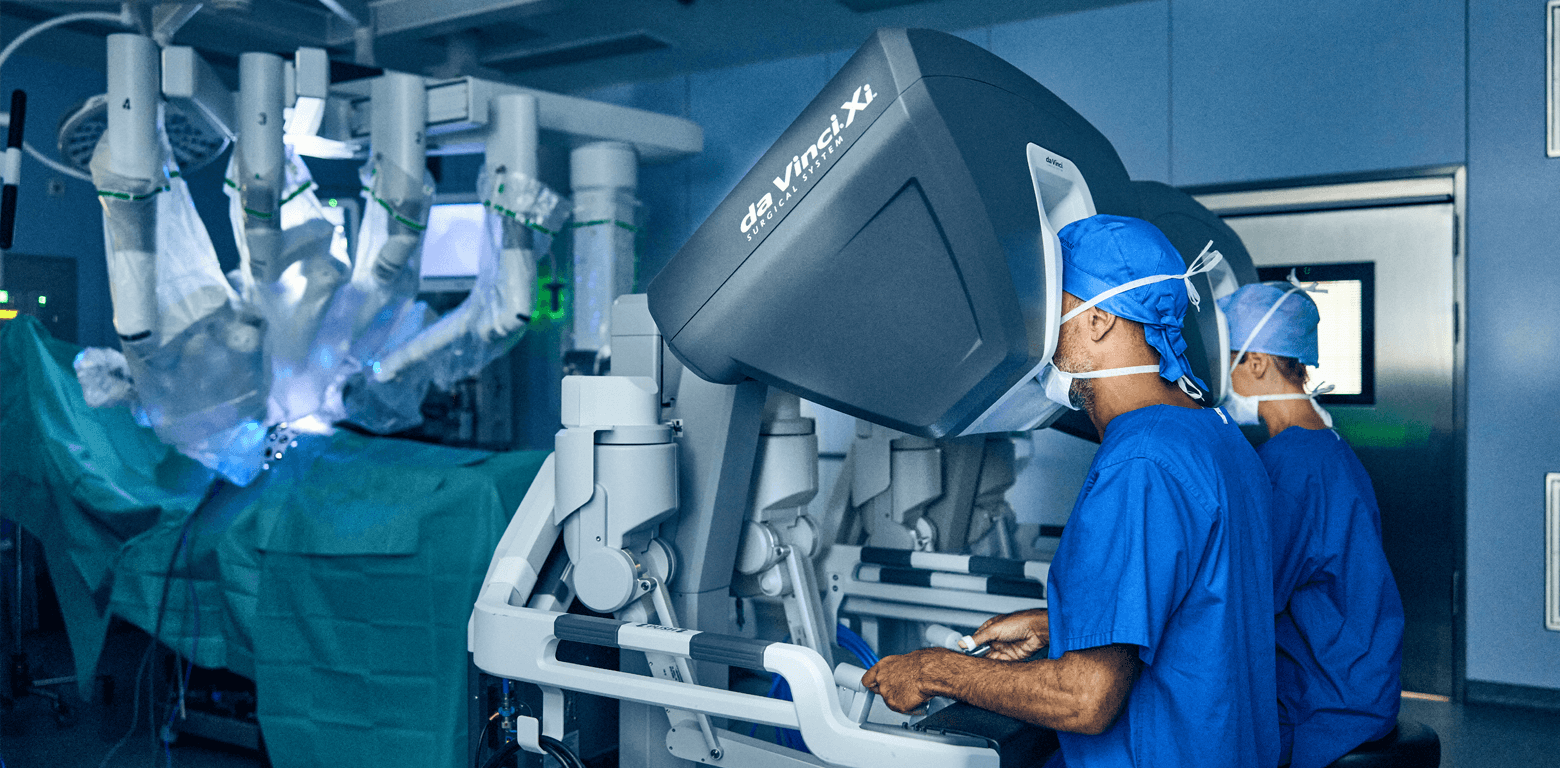
Robotic surgery is the modern way to perform surgical procedures. Without compromising the surgical result and the safety of the patient, we offer high-quality services with less surgical complications in comparison to the traditional open surgical procedures. Millions of patients that have undergone procedures including the use of surgical robots, internationally, report a quicker recovery and return to their daily activities thanks to this technology.
The robotic operations include small incisions to the skin (approximately 8 millimeters) through which the tools and the camera of the robotic system are inserted. The tools and the visual system are controlled by advanced robotic controllers, which are operated exclusively by the surgeon and they translate the movements of the fingertips in very detailed movements of the surgical tools.
In the United states of America, where the robotic surgery is applied from the beginning of 2000, the gynecological operations consist of the majority of the operations that are performed using the robotic technique. This fact confirms that even in this sensitive sector, the robotic surgery is the modern laparoscopy.
Τhe use of robotic surgery is gradually growing in the field of gynecology. It includes from the treatment of benign tumors - fibromyomas and dysfunctional uterine bleedings up to complex oncological procedures for the treatment of gynecological cancer.
The advantages in comparison with open operations and the traditional laparoscopy can be described by statistical data which include.
- the days of hospitalization of the patient
- the loss of blood
- the need of the intraoperative conversion of the procedure to an open procedure because of inability to complete it laparoscopically
- the days that the patient needs to return to her work
- the size of the surgical specimen
- if the patient needs to undergo the previous operations in the abdominal region (surgical history)
Concerning all the above-mentioned facts, it has been proved that the robotically assisted surgery in gynecology could give answers to the following:
- one-day hospitalization
- less loss of blood
- less interoperative complications, even for complex operations (increased number of adhesions because of previous operations, large fibromyomas – surgical specimens > 250 gr), smaller percentage of complications during the first 30 postoperative days, smaller percentage of need for a new admission to the hospital after the operation in comparison to the open surgery and traditional laparoscopy
- the patient returns in 2 weeks fully to her social activities and the most of them in 4 weeks to their work uneventfully.
At the same time, there are studies that confirm the new fields of surgical criteria based on the technological advances. In this way, the integrated 3D HD camera of the robotic system can, improving the senses of the surgeon, help the recognition of more sites of endometriosis, both superficial and much more in deeper tissues.
The resection of fibromyomas and the surgical treatment of endometriosis are the majority of the operations that needed for the improvement of the percentage of successful pregnancies.
The stability of the robotic system in comparison with suturing and restoration of the anatomical structures offer huge benefits concerning the protection and the preservation of the structures to women in reproductive age.
The robotic surgery can treat in detail and with exactness in handling, the accurate restoration of the surgical structures, whereas it causes less adhesions. In this way, it is the ideal way of treatment of endometriosis and also of operations to improve the fertility of subfertile couples.
Treatment of gynecological cancer
Specifically, in the sector of gynecological cancer, the use of robotic surgery has changed radically the surgical treatment of the disease and specifically of the endometrial and cervical cancer.
Since the introduction of the robotic system in medical practice and its recognition by FDA in 2005, a huge turn is accomplished to the robotic surgery, exactly because of its advantages in comparison to the open approach and the laparoscopic technique.
These operations include, in the majority of the cases, total hysterectomy including adnexa and extended pelvic lymph node dissection (resection of pelvic lymph nodes)
(Figure)
Physicians, all over the world, because of the complexity of the cases of the oncologic patients (aged patients with comorbidities - cardiovascular, respiratory problems, frequently a lot of previous operations – cesarean sections - resections of fibromyomas, etc), find the solution to the robotic surgery, in order to offer high-quality services.
These services are correlated with the resection of more lymph nodes, less postoperative complications, such as wound infections, respiratory infections, systematic infections and injuries of structures neighboring with the internal gynecological organs, in comparison with the traditional laparoscopy and the open operations.
The improved and oncologically safe result makes the robotic surgery internationally the firstly selected procedure for the gynecological cancer of endometrium and cervix uteri. The international guidelines propose, where this is possible in the gynecological cancer of endometrium, to follow the minimally invasive way of treatment, confirming the superiority and the safety of this technique.